
(via Paul)

Manuel Simoni's blog about programming (languages).
The scheme community is now very invested in its macrology; they got there by long hard work and emotional processing and yelling and screaming and weeping and gnashing of teeth, and they still remember the pain of not having a standard macrology. You will not pry it away except from their cold dead fingers, and you will not redefine it without defeating them in mortal combat.I think the commenter misunderstood my earlier post. Syntactic extension is absolutely necessary, and modern Scheme macro systems are a fine way to do it.
It has been my impression that, no matter what specific thing you use macros to do, you can later invent a neat language feature that handles the problem in a clean and nice manner. The problem is the "later". Macros can do it "now"... in an ugly, brutish manner, true, but the job gets done. ...
Even among people who find macros smelly, you'll find many who think macros the least distasteful of these choices.John Shutt's response ties this in with fexprs - instead of delegating the job to a separate preprocessing step, let the language itself have the power of self-extension:
Macros are an unpleasant feature to compensate, somewhat, for limitations of a language. It's better to compensate for the limitations than to leave the limitations in place without compensating at all. Better still, though, would be to eliminate the offending limitations. (Remove the weaknesses and restrictions that make additional features appear necessary.) Make no mistake, fexprs don't necessarily increase the uniform flexibility of the language; but with care in the design they can do so, and thereby, the jobs otherwise done by macros are brought within the purview of the elegant language core. So instead of an ugly brutish fix with macros now and hope for a more elegant replacement later, one can produce a clean solution now with fexprs.PS: This point is subtle. After all Scheme is already self-extensible. But Scheme macros still are an additional "layer" on top of, and separate from, the core language. Kernel's fexprs are not - they are the core language, thus bringing self-extension within the purview of the elegant language core.
"The internet is practically the only real object-oriented system on the planet." (~30:00)
SRII 2011 - Keynote Talk by Alan Kay - President, Viewpoints Research Institute from SRii GLOBAL CONFERENCE 2011 on Vimeo.
Also, the notion of reinventing the flat tire can't get enough airtime.
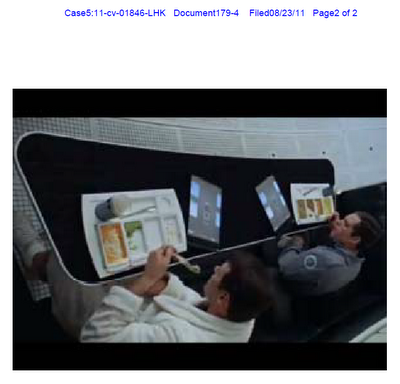
Attached hereto as Exhibit D is a true and correct copy of a still image taken from Stanley Kubrick's 1968 film "2001: A Space Odyssey." In a clip from that film lasting about one minute, two astronauts are eating and at the same time using personal tablet computers. The clip can be downloaded online at http://www.youtube.com/watch?v=JQ8pQVDyaLo. As with the design claimed by the D’889 Patent, the tablet disclosed in the clip has an overall rectangular shape with a dominant display screen, narrow borders, a predominately flat front surface, a flat back surface (which is evident because the tablets are lying flat on the table's surface), and a thin form factor.
"Virtual" does not mean, as many think, three-dimensional. It is the opposite of *real*.
Virtuality therefore means the *apparent structure of things*
Engineers generally deal with constructing reality. Movie-makers and software designers deal with constructing virtuality.
Software is a branch of movies.
Movies enact events on a screen that affect the heart and mind of a viewer. Software enacts events on a screen which affect the heart and mind of a user, AND INTERACT.
The meme set carried by the [memetic] organism includes a mass of theories, some of which contradict each other. At the center of this mass is a nucleus of theories that are supposed to be believed (part of what Kuhn called a paradigm). Surrounding the nucleus are theories that are meant to be contrasted with the paradigm and rejected, together with memes about how to conduct the contrast; one might call this surrounding material the co-nucleus.
"Nerd? We prefer the term intellectual badass." – UnknownAMD Fusion Developer Summit Keynotes, about AMD's upcoming "Cray on a Chip". Basically, they'll make the parallel processors (formerly known as GPUs) coherent with the brawny sequential CPUs, allowing you to "switch the compute" between sequential and parallel, while operating on the same data (e.g. fill an array sequentially, then switch to parallel processing to crunch the data, all in the same program - and memory space).
($define! $lambda
  ($vau (formals . body) env
     (wrap (eval (list* $vau formals #ignore body)
                 env))))
Through the power of fexprs, Kernel needs only three built-in operators (define, vau, and if) as well as some built-in functions. This is vastly simpler than any definition of Scheme! Scheme built-ins such as lambda, set! (!), define-syntax and others fall directly out of fexprs, for free, radically simplifying the implementation. But I'm rambling.This [not properly tail-calling] behavior of the SECD machine, and more broadly of many compilers and evaluators, is principally a consequence of the early evolution of computers and computer languages; procedure calls, and particularly recursive procedure calls, were added to many computer languages long after constructs like branches, jumps, and assignment. They were thought to be expensive, inefficient, and esoteric.Guy Steele outlined this history and disrupted the canard of expensive procedure calls, showing how inefficient procedure call mechanisms could be replaced with simple “JUMP” instructions, making the space complexity of recursive procedures equivalent to that of any other looping construct.
Though OOP came from many motivations, two were central. ... [T]he small scale one was to find a more flexible version of assignment, and then to try to eliminate it altogether.
John Shutt would like to break the chains of semantics, e.g. using fexprs to reach under-the-hood to wrangle and mutate the vital organs of a previously meaningful subprogram. Such a technique is workable, but I believe it leads to monolithic, tightly coupled applications that are not harmonious with nature. I have just now found a portmanteau that properly conveys my opinion of the subject: frankenprogramming.I'm looking forward to John's reply. In the meantime, I have to say that I like to view this in a more relaxed way. As Ehud Lamm said:
Strict abstraction boundaries are too limiting in practice. The good news is that one man's abstraction breaking is another's language feature.


